Exterior Architectural Lighting for Qatar's Commercial & Cultural Buildings
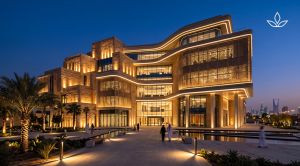
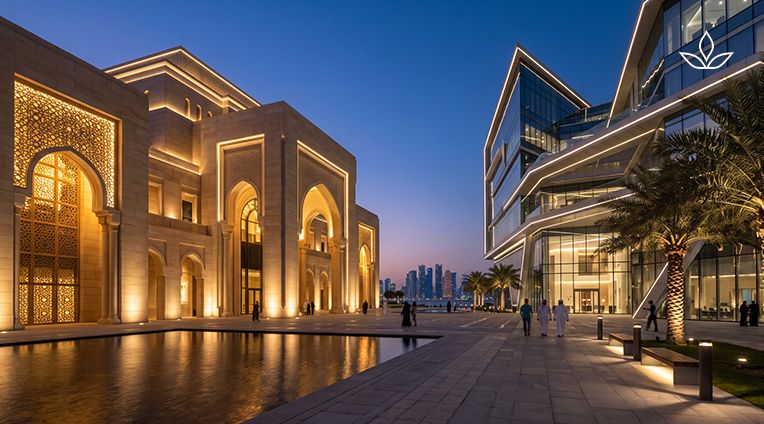
At night, Doha's skyline sorts itself out. Towers that blend into the haze by day separate from one another after dark, and the buildings that hold their identity best are the ones where exterior lighting was specified as part of the design brief, not added on afterward. For architects, developers, and facilities teams working on landmark projects in Qatar, lighting isn't a finishing touch. It's a system that has to be specified, procured, and maintained like any other piece of building infrastructure.
This is much easier said than done, since heat, humidity, and airborne sand can be hard on outdoor fixtures, as can buildings that require extended lighting periods. Lumascape’s facade, in-ground, and direct-view ranges are designed for demanding exterior environments, with marine-grade materials, sealed construction, high IP ratings and thermal management features available across its product range.
Below is how that product range maps onto the structure types most common on Qatari commercial and cultural projects.
Large Buildings Deserve Light That Matches Their Ambition
Office towers and mixed-use developments carry a lot of their commercial identity in their facade at night, and that facade is rarely one material. Glass, stone, and metal all reflect light differently, so a single fixture spec applied across the whole envelope tends to produce uneven results at height. Specifiers need fixtures that scale; enough output to read clearly from street level or a distance, with beam control tight enough to model the building's architectural lines rather than just flooding the surface.
Products
Quadralux Q8 — High-output spotlight for long-throw illumination of tall facades and large architectural surfaces.
Linealux L3 — Linear grazer for highlighting facade lines, columns, edges, and architectural details.
Monuments and Landmarks Call for Light That Knows When to Hold Back
Museums, governmental buildings, and historic buildings have an entirely different mandate from all others. It is not about making a bold statement; rather, it is to showcase the architecture that already exists. This is done through more subtle uplighting, good control over the luminance and color temperature around the facade or exhibit, and small light fixtures to keep them out of view. In-ground or direct-view installations are preferred here because they allow precise focus of light where needed without bringing the fixtures into view themselves.
Products
Quadralux Q2 — Compact spotlight for close-range accent and detail lighting on facades.
Linealux L1 — Linear grazer for fine lighting along stonework, columns, and architectural trim.
Bridges and Infrastructure Demand Light That Travels With Purpose
Bridges and civil infrastructure introduce their own constraints: longer spans, exposed mounting conditions, and a need for output that stays legible from a distance and from multiple viewing angles, often over water or open roadway. These projects also tend to demand higher vibration resistance and IP ratings, since the fixtures are more exposed to environmental load than a typical facade installation.
Products
Quadralux Q4 — Mid-range spotlight for illuminating spans and structural elements.
Quadralux Q6 — Higher-intensity spotlight for longer distances and larger structural surfaces.
Curved and Sculptural Forms Reveal Themselves Under the Right Beam
Fountains, sculptures, and buildings with curved or angled facades don't respond well to fixed-beam optics. This is a genuinely different lighting problem, which is why it calls for a genuinely different fixture: one with a rotating beam that can be adjusted to the geometry of the surface rather than the surface being adjusted to the fixture.
Products
Kololux K6 — High-output spotlight with rotating Kompass beam technology for curved, angled, and sculptural surfaces.
Kololux K8 — High-output spotlight with rotating Kompass beam technology for larger or more demanding sculptural applications.
Pathways Need Light That Guides Without Getting in the Way
Pathways around commercial, cultural, and public spaces need consistent illumination for clear visibility without creating unnecessary glare or visual clutter. The right fixtures should provide comfortable, controlled light while fitting naturally into the surrounding landscape and architecture.
Products
Rise RS8 — High-output bollard for pathways and larger pedestrian areas.
BA1 — Compact bollard for controlled lighting along pathways and walkways.
Designed for the Climate, Not Just the Look
None of this design would be possible without the lights being able to withstand the environmental conditions in which they are installed. The lights installed on buildings in Doha should be able to withstand high temperatures and should not corrode. It's a real consideration for facilities budgets, not just a spec sheet detail.
Conclusion
A well-lit building tends to stay in people's memory longer than one that isn't, and for Qatar's commercial and cultural landmarks, getting there starts with specifying fixtures built for the application, not just the aesthetic. Lumascape's product range is built to cover that full brief: from high-intensity floodlighting for towers and long-span bridges, to restrained accent and grazing light for heritage and civic structures, to rotating-beam optics purpose-built for curved and sculptural forms. Whatever the structure, Lumascape engineers facade, in-ground, and direct-view lighting to handle it, giving architects and developers one supplier to work with across the full range of illumination a landmark project demands.