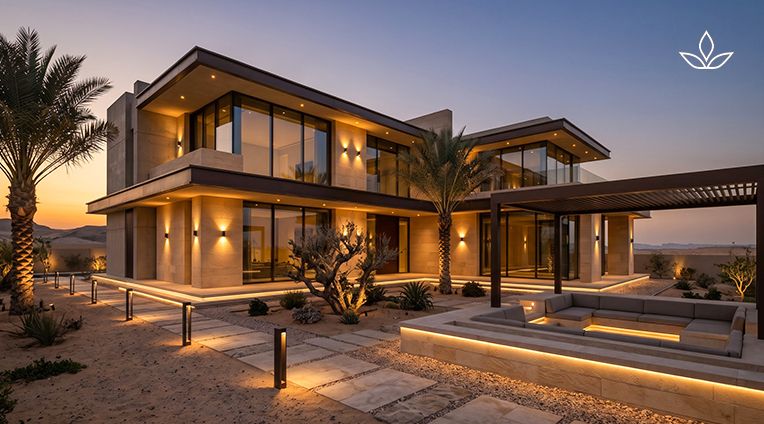
How to Choose Exterior Lighting for the Middle East Climate
From the desert landscapes of the UAE and Saudi Arabia to the coastal environments of Qatar, the Middle East presents exterior lighting with challenges of its own. Intense heat, strong UV exposure, dust, sand, humidity and salt laden air can test a luminaire long before its light is noticed.
With a legacy built around the mastery of architectural lighting, Lumascape brings decades of expertise in creating lighting solutions designed to perform in demanding environments, including some of the Middle East's most distinctive architectural and landmark projects.
So, what does it really take for a luminaire to withstand the Middle Eastern climate while still bringing architecture to life after dark?
The answer begins with understanding the region and choosing lighting engineered for it, not simply for the night.
First, Look at What the Sun Can Do
In this region, sunlight is more than a source of daytime illumination. Prolonged exposure to intense UV radiation and high temperatures can affect lenses, finishes, polymers, LEDs and drivers.
That makes these factors worth checking before installation:
- Maximum ambient temperature
- UV resistance
- Thermal management
- LED and driver lifetime at elevated temperatures
- Material durability under prolonged sun exposure
Technologies such as Lumascape's CoolDrive are designed to manage light engine and driver temperatures within safe operating limits, an important consideration for demanding exterior environments.
But once the heat is accounted for, another challenge begins to settle over the fixture.
Then Comes the Dust
Fine dust and sand are unavoidable considerations across much of the Middle East. And while a little surface dust may seem harmless, the real concern begins when environmental particles find their way inside a luminaire.
This is where ingress protection becomes important.
Depending on the application, IP65, IP66, IP67 or IP68 protection may be appropriate. The right level depends on whether the fixture is installed on a facade, in a landscape or below ground, and how directly it is exposed to water and environmental contaminants.
Yet for Dubai, Abu Dhabi and other coastal locations, keeping dust and water out is not the only concern.
What About the Salt in the Air?
Coastal humidity combined with salt laden air can accelerate corrosion, potentially affecting both appearance and long term performance.
For these environments, look for:
- Corrosion resistant materials
- Suitable stainless steel grades
- Durable protective finishes
- Properly sealed components
- Materials suited to high salinity environments
Lumascape incorporates corrosion resistance, UV protection and ingress protection across its exterior lighting solutions, with material and finishing options designed for demanding applications.
But surviving the climate is only half the story.
What happens once the light actually reaches the architecture?
The Beam Has a Job to Do
A Middle Eastern facade can be monumental, highly detailed or richly textured. One beam cannot reveal all of that in the same way.
The optical design therefore matters just as much as the fixture itself.
Consider:
- Narrow beams for architectural details
- Wider distributions for larger surfaces
- Grazing to emphasise texture
- Wall washing for more uniform illumination
- Adjustable aiming for flexibility
- Glare control for comfortable viewing
The objective is not to flood a building with light. It is to reveal exactly what deserves attention.
And then comes the detail that can change the entire mood.
The Role of Colour in Architectural Lighting
Colour temperature influences how materials and architecture are perceived at night. Warm white can complement stone, hospitality and luxury environments, while cooler tones can create a sharper contemporary appearance.
For projects requiring greater flexibility, tunable white and colour changing systems can introduce different scenes for events, seasons and special occasions.
But who controls all those possibilities?
Make the Lighting Smarter
For large facades, landscapes and landmarks, intelligent controls can enable precise dimming, scheduling and scene management while helping reduce unnecessary energy consumption.
Maintenance deserves the same attention. A fixture installed high above a facade is very different from one placed at ground level. Accessibility, service life and ease of replacement should therefore be considered before installation, not after a problem occurs.
Lumascape's exterior portfolio brings these considerations together across facade, landscape, pathway and in ground applications, supported by technologies focused on thermal management, UV protection, corrosion resistance, ingress protection, optical control and digital lighting management.
Final Thought
In the Middle East, exterior lighting has to satisfy two very different demands. It must be resilient enough to withstand the environment, yet refined enough to make that resilience invisible.
From the heat and UV exposure of the desert to the humidity and salt laden air of the coast, every environmental challenge becomes part of the lighting decision. Beyond protection, there is the equally important task of shaping the right beam, colour and atmosphere for the architecture.
The most considered lighting solutions bring these elements together, allowing technology to work quietly behind the scenes while the architecture takes centre stage.
Because when lighting is truly designed for its environment, it does more than withstand the night. It gives architecture a presence that stays with you long after the lights come on.