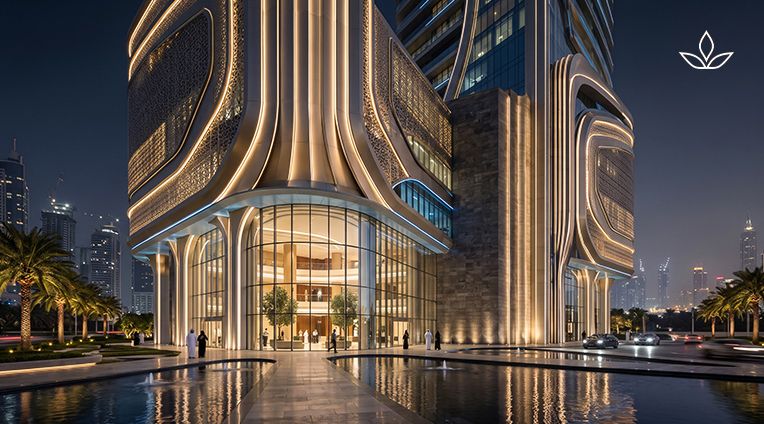
Facade Lighting Trends in the Middle East for 2026
What if the most memorable part of a building only appears after sunset?
In the Middle East, where architecture is often created to impress, the night can reveal an entirely different side of a structure. A facade can glow with subtle elegance, monumental forms can emerge from darkness, and even the finest surface details can become part of a carefully crafted visual experience.
Creating that transformation, however, takes far more than putting lights on a building.
This is where Lumascape, an internationally established architectural lighting specialist with projects and distribution spanning the globe, brings decades of lighting expertise to the built environment. Founded in Australia in 1991, Lumascape has grown into a global manufacturer of exterior architectural, landscape and underwater lighting, with its technology illuminating buildings, bridges, monuments and public spaces across more than 40 countries.
And when that expertise meets the ambitions of Middle Eastern architecture, the possibilities become particularly intriguing.
The Facade Is No Longer Just a Surface
A facade has texture, depth, curves, edges and architectural features that behave differently under light. The challenge is knowing what to highlight and what to leave untouched.
Lumascape’s Facade range is built around this very principle. Quadralux Q2, Q4, Q6 and Q8 provide progressively higher-output options, from focused accent and grazing applications to larger facades and long-distance illumination. Linealux brings linear grazing to architectural edges and details, while Kololux K6 and K8 use rotating-beam projection for curved, angled and sculptural forms. Fayra F6-P adds a compact projector for facade, landscape and civic applications.
The technical difference may sound small. Visually, it can change everything.
Light as Part of the Facade
One of the most refined directions in facade lighting for 2026 is the move towards discreet, integrated illumination.
Consider the Loro Piana at Dubai Mall. Lumascape’s Linealux L5 linear grazers were concealed behind the boutique’s cylindrical copper-toned facade elements. The resulting warm glow follows the forms, revealing their texture and creating subtle movement as people pass by.
The luminaires are barely part of the visual story. The facade is.
That is the hallmark of thoughtful architectural lighting: technology performs its role without competing for attention.
The Precision Behind the Glow
What appears effortless from the outside is often the result of very deliberate technical decisions.
Beam angle, light distribution, output, colour temperature, glare control, mounting and digital control all influence how a facade is ultimately perceived. Lumascape’s product ecosystem is designed to give lighting professionals control over these details, while its intelligent PowerSync technology supports digital dimming and control across compatible luminaires.
This becomes even more important when the project is not simply a building, but a landmark.
How Light Shapes a Landmark in Abu Dhabi
At The Founder’s Memorial in Abu Dhabi, Lumascape’s expertise was put to work on one of the region’s most remarkable illuminated installations.
The centrepiece, The Constellation, is a monumental three-dimensional portrait of Sheikh Zayed formed from more than 1,327 stainless steel elements suspended on over 1,110 cables inside a 30-metre-high pavilion. Lumascape supplied 1,985 luminaires, with their positions carefully determined to support the artist’s vision rather than being evenly distributed.
The installation combines 1,203 floor-mounted uplights and 782 ceiling-mounted downlights, all using a 3000K colour temperature and 10° beam angle. PowerSync and DMX control provide the precision needed to adjust intensity and aiming across the installation.
Here, lighting is no longer simply revealing architecture.
It is helping create the experience of architecture.
So, What Will Define Facade Lighting in 2026?
The answer may not be brighter buildings. It may be better considered light.
Concealed fixtures. Controlled grazing. Precisely selected beams. Lighting that responds to materials and form. Intelligent systems that give designers greater control. And solutions that are selected according to the nature and scale of each project.
Lumascape’s work in the Middle East shows how these principles can move from specification to reality: from the restrained glow of a luxury facade at Dubai Mall to the extraordinary precision of The Constellation in Abu Dhabi.
Because great facade lighting does not merely make a building visible after dark.
It gives the architecture another moment to be remembered.